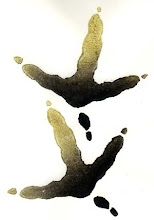
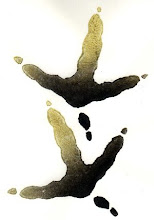
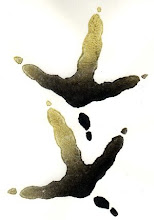
We had a great time at Twin Moose! In camp we had Clayton, Pete, Bill S., KGT, Rich, and Josh. We were pretty short on dogs, with Lilly and Maya getting all of the work (and Brant guarding the camp mostly). Despite over 35 flushes before the close of camp on Monday night (and about a dozen more throughout the week while deer hunting after), we were unable to kill any grouse. We did, however, have a great time together, and I felt immense joy about the camp being full of great old friends.
On the last day, Josh and I went out for a leisurely stroll with guns, with Brant. We worked up a rabbit and as I shot it, a grouse flushed from over head. So went Grouse Camp at Twin Moose. We established that there is indeed a healthy grouse population right on the property, and certainly on the many thousands of acres adjacent.
I hope other grousers will post pics...
Showing posts with label Adirondacks. Show all posts
Wednesday, October 29, 2014
Friday, May 17, 2013
Wednesday, July 11, 2012
Guest post from Michael M.
One of our old friends at Grousers, Mr. Michael Mieszczak, weighed in recently with his thoughts about what he found on the website of Orion, The Hunters' Institute. Enjoy.
Tuesday, July 10, 2012
Orion Doesn’t Fence Around Fair Chase
Posted by Michael M. at 7:56 AM
When it comes to hunting and fishing, the gang at Cold Duck all consider ourselves to be “good sports.” We’ve never actually sat down together and tried to nail down just what “being a good sport” means. We buy all our required licenses and permits; never shoot or fish above the limit; reflexively let a youngster, or a newbie, or someone with challenges take the first shot or fish the best pool; and, if we kill it, you can be darn sure we’ll enjoy eating it. These behaviors, and a few activity-specific others that we’ve picked up along the way, have pretty much let us feel we’re good sports even if, as admitted earlier, we haven’t spent a lot of time parsing out the term.On a random scoot through the Internet recently, I learned that some people care a whole lot about good sportsmanship, or what they call Fair Chase. Jim Posewitz founded Orion - The Hunters’ Institute in 1993 to pursue the stated goals of “cleaning up” hunting’s image and of placing hunters in the leadership position in defining and guarding our nation’s conservation ethic. I found all sorts of interesting reading at the website and its associated blog, Fair Chase Hunting.A core element of Orion’s outlook is that hunters should only occasionally succeed, but the animals should generally “win” by avoiding being taken. If Jim had been following me and my perpetually underweighted game bag around NY’s fields and swamps, he would never have seen need to form his organization. Apparently there are plenty of outfits out West that offer the opportunity to “hunt” large game-species mammals that’re penned up in enclosures of various sizes; and Posewitz condemns both the outfits and their customers to the farthest regions of Dante’s Inferno.Jim and his crew have lots of other ideas as well. Orion would like to see large tracts of wilderness preserved so that wild resources will be democratically available to hunters of all economic strata. I bet you’ll enjoy roaming through Jim’s website as much as I did, and so rather than try further to reduce his group’s prodigious efforts to 50-words-or-less here, I recommend you click on the link and give it a tumble.When you do, you’ll love the photos of Bighorn Sheep and snow-covered Rocky Mountain vistas. Check out this beauty from Orion’s homepage:While some NY hunters may daydream of chasing those Bighorns out West, we at Cold Duck genuinely prefer hunting feathered or furred small game behind our doggies of choice. I’d love for Orion to expand on its Western large game focus and speak to the hunting that many of us do in the East. Come on, Orion, let us know what you think of chasing Adirondack snowshoe hares behind bawl-and-chop beagles, or “rough shooting” grouse, woodcock and ducks behind a busy-tailed flushing spaniel up on Tug Hill.
from Orion - The Hunters' Institute's website ![]()
Monday, May 14, 2012
Monday, September 26, 2011
ADK Bear Camp 2011
Bear Camp 2011 has ended, and there are no bear steaks to distribute to Grouser friends. I had a great time, though, exploring the environs of my new ADK camp, christened Twin Moose.
I made camp with a friend two days before the opener of early bear season on the "middle landing" of the timber lands I am leasing in the Big Moose tract, near Big Moose station, Twitchell Lake, and Big Moose Lake. The weather was unseasonably cold and we spent the first few nights dealing with the hardest September frosts anyone up that way could remember. But it felt like hunting season, and all was well, so long as you had a mummy bag and some good whiskey. I had both.
![]() |
| Bear Camp on the middle landing |
![]() |
| Another view of Bear Camp. |
My friend Paul and I fished Twitchell Lake and scouted on the first day and probably spent too much time crashing through the thick stuff bushwacking the property lines. It is my opinion that we sent a bear right through the camp the day before the season, and I could hear my dog Artemis going absolutely ballistic like I have never ever heard her sound before. We could find no bear sign in camp, however.
![]() |
| Twitchell Lake at sundown. |
On opening morning, we were up long before dawn and made a hearty eggs and sausage breakfast complete with Cagey's campfire coffee. We flipped for stand selection and Paul won the toss. He selected "the bench" stand, a stand up on a bench between two beech ridges. Its a great spot. That left me with the stand along one of the two beaver ponds on the lease, along a recently cleared logging road-come-snowmobiling trail. There was game sign of all kinds in the mud there a-plenty- deer, turkey, fox & coyote, and older not-so-fresh bear sign. And there were moose tracks.
After a few uneventful but stunningly beautiful early morning hours on stand, where I watched the frost melt from the leaves of the reddening maples and heard it rain down on the still lush forest floor like a spring shower, I was jolted from my reverie by the sounds of crashing brush and snapping twigs coming down the mountain to my south east. The sounds got closer and louder, and my heart raced as I raised my gun (the trusty drilling) and began to collect a site picture through the scope of a spot on the logging trail where I expected the dark and large sounding bruin to pop out. As I found a rest on the tree, the brush rustled and a branch snapped at the overgrown-with-brambles trail's edge. Any second. I saw movement. I saw a a dark shape. It poked out its head and there stood before me a massive brown horses head. I blinked. "What the f*#$?!" could be heard in the Adirondack wilderness. As my mind raced to make sense of what was unfolding before me, and as I watched through the scope, the "horse," after pausing a few seconds to make sure the coast was clear, stepped into the clear. The cross hairs drifted to vitals as this beast stood broadside. And then, out plopped one, then two, miniatures of the big long-legged creature, which I was now identifying as Alces alces americana. Now, I have seen a few moose, but never a cow with a calf, certainly not a cow with twins, and most definitely not within bow range broadside. This was just simply COOL.
The moose hung around abit, winding me, and causing me to remain frozen for as long as I could rather than make movements to lower my gun and try to retrieve my camera. They finally ambled off, to the north west, vaguely in the direction of Paul, who was about a mile away. The excitement was over by about 9:30 am.
I spent the rest of my morning hunt relishing what I had witnessed, and basking in the good fortune that was mine in seeing any moose at all in the Adirondacks.
Almost unbelievably, it turns out that about a half hour later, the same three moose passed directly under Paul's stand as well. He, though, was, er, resting, and was awakened by the sound of a rock being kicked. He opened his eyes, saw moose, and grabbed a camera. What are the odds?! The odds of me seeing a moose, never mind three moose, including twins at that, are slim indeed. But the odds of Paul seeing them as well, almost a mile away in thick country, the same day--- now that is damn near auspicious. Hence, the camp has been named Twin Moose Camp.
![]() |
| Cow moose and twin calves, 2011. |
The following day's hunt was uneventful and I bid Paul a goodbye. I remained in camp for another few days, a week in total, exploring, paddling ponds, pointing and flushing grouse into impenetrable labyrinths of leafiness. It was bliss, but no bear.
![]() |
Tuesday, July 12, 2011
Friday, June 24, 2011
Thursday, June 02, 2011
Charlotte's First Brookie

On a recent May trip to the ADKs for brookies and turkeys, my youngest, Charlotte, nailed her first brookie, casting a Mepps Aglia from a canoe on Black Pond near Paul Smiths. She was thrilled; daddy couldn't have been more proud.
The annual May 'Daks trip usually yields pretty good catches of trout, but with the heavy winter and crazy spring flooding, the creel was lighter this year. We did catch some very nice fish in the North Branch of the Mooser River Drainage, and of course, I caught a few on Black Pond, as is to be expected there.
The turkeys wouldn't cooperate, though I did voice-call a nice Tom away from two hens with Mo and the girls with me, to 10 yards...but it was after noon. He was SOOOO dead, at least in all of our imaginations. It was cute to hear Charlotte and Victoria whisper "bang" every time he stuck out his neck and gobbled thunderously. Next time.
Thursday, May 27, 2010
Mo's Brookies

So, I will be posting a more complete report on our family outing in the ADKs on Farm, Fur, Fin, Feather soon. We canoe camped in the Paul Smith's Brook Trout Management area, just north of the St. Regis Canoe Wilderness . We focused our fishing on Black and Long Ponds. According to Fishing Eastern New York by Spider Rybaak, both were reclaimed with chemicals in 1997 and now support Windfall-strain brook trout indigenous to New York. The 73-acre Black Pond is completely surrounded by forest and has an esker running along its west bank. Its average depth is 20 feet and the maximum is 45 feet deep. Spread over 14 acres, Long Pond is completely surrounded by forest, shrubs, and wetland. Averaging 9.5 feet deep and dropping to a maximum depth of 20 feet, it feeds Black Pond. Two dams—one at the canoe launch on the pond’s outlet, the other on the channel halfway to Black Pond—prevent fish movement between the two.
As Many of you know, Mo was injured 10 months ago. This trip was important for her in that it was her opportunity to push herself and simultaneously assure herself that she is no longer "broken." She seems like a new person after the trip. As Rich has said, God Bless the 'Dacks.
The film clip was shot June 24th, 2010--- ten months to the day from her accident. Solo canoe fishing, paddling in the Adirondacks, sleeping on the ground. I'd say she's back. Mark July 24th, 2010 on your calendars--- we are throwing a BIG party.
Wednesday, May 28, 2008
Moose, ADKs, and Cornell alum scientists
Moose Gain Ground but Keep a Low Profile
By LISA W. FODERARO McKENZIE
MOUNTAIN WILDERNESS, N.Y.
From the New York Times
Here in the boreal forests of the Adirondack Mountains, moose are seemingly everywhere and nowhere.
In the sachet-scented gift shops of Lake Placid, where high heels outnumber hiking boots, there are moose-inspired cookie jars, moose-shaped soaps, moose-head lollipops, moose-emblazoned kitchen mitts and a $12.95 book titled “Uses for Mooses and Other (Silly) Observations.”
But while it may be the overworked mascot of the Adirondacks tourist trade, the moose, which has quietly returned to northern New York over the last quarter-century, remains a mystery. Many longtime residents have never glimpsed one. And wildlife biologists are unsure whether the small but secure population of some 400 moose is on the verge of an explosion — as happened in New Hampshire in recent decades — or headed for an eventual decline because of global warming.
“It’s the icon of the north woods,” said Heidi E. Kretser, a scientist with the Wildlife Conservation Society, the nonprofit organization that operates the Bronx Zoo and has an outpost in the Adirondacks. “They’re massive creatures. They’re just very appealing characters.”
To better understand their lifestyle and behavior, the Wildlife Conservation Society sent specially trained dogs into the piney woods here recently, not in search of actual moose, but their scat, or excrement. One morning this month, Camas, a German shepherd who had traveled from Montana for the mission, traversed the dense wilderness around Moose Pond. The forest floor was just springing to life, with wood sorrel and striped maple saplings pushing up through dead leaves and ferns unfurling.
But in a sign of moose elusiveness, Camas found the scat of black bear and ruffed grouse but nothing redolent of moose, even though there had been recent sightings in the area. (The day before, a colleague of Camas had more luck, sniffing out nine discrete examples of moose scat; the conservationists organized 20 such outings between May 12 and May 25, in a program financed in part by the Natural History Museum of the Adirondacks, popularly known as the Wild Center, in nearby Tupper Lake.)
By analyzing the scat, the society hopes to learn more about the habits, genetics and overall health of New York’s moose population.
But with only a few hundred moose scattered across the Adirondack state park, which comprises private and public lands in an area roughly the size of Vermont, locating moose scat is far easier than locating the actual mammals, despite their hulking size. (Bull moose can weigh up to 1,400 pounds and eat 40 to 60 pounds of vegetation a day.)
Scat analysis is less traumatic for moose than more traditional techniques. “It’s not a replacement for collaring, but it’s another tool for managers and researchers and it’s noninvasive,” Dr. Kretser said. “You eliminate the stress of darting the animal.”
Moose were hunted out of existence in the Adirondacks just before the Civil War, but began to tromp back into the state in the early 1980s, entering from Vermont and Canada. Wildlife experts expect their numbers to continue to climb, but they also speculate that the moose, which rely on birch twigs, maple bark and other vegetation found in northern hardwood forests, could eventually retreat. The animals could leave the Adirondacks for points farther north, after decades of global warming.
“We’ll see the population double in size,” said Chuck Dente, a big-game biologist for the State Department of Environmental Conservation, noting that Vermont and New Hampshire each have several thousand moose. “The more moose you have, the more they can reproduce very quickly and successfully.
Once they get established, the population can take off. But what happens after that, we don’t know. We have a group of scientists working on the ramifications of climate change.”
Recent moose necropsies — the equivalent of autopsies — have revealed that a parasite called brain worm is taking a toll on moose here. The worm gets into the brain cavity and the spinal column and ultimately kills the moose.
Mr. Dente said that rising temperatures in the coming decades could lead to more brain worm, which is part of a complex food chain involving snails, as well as other parasites. “As things warm up a little bit, that allows the snail to survive better,” he said.
Whereas black bears, which number about 5,000 in the Adirondacks, are considered a nuisance by some, foraging for garbage, moose pretty much keep to themselves. If their numbers grow, however, so will the possibility of moose-vehicle collisions, and state officials and wildlife advocates are girding for a backlash in public perception.
In New Hampshire, which is home to about 6,000 moose, there are 200 to 250 collisions involving moose each year. Human fatalities are rare, but there have been serious injuries.
By contrast, Adirondack Park, which contains virtually all the moose in New York State, has an average of four to six collisions a year, and none so far, environmental officials say, have been fatal to the drivers.
Several weeks ago in Saranac Lake, for instance, a moose was killed after being struck by three vehicles in a row.
“Hitting a moose is a nasty thing because you really don’t see them,” Mr.
Dente said. “They’re a solid color at night, and they’re so tall that you don’t get the reflections of their eyes from the headlights. You don’t see them until you’re right on top of them.”
For now, their presence in the Adirondacks is more a source of fascination than vexation. “The moose are kind of mysterious,” said Julie Outcalt, a sales clerk at the Adirondack Museum store on Main Street in downtown Lake Placid, where shoppers can choose among moose-head bookends ($130) and a birch-bark moose figure ($42). “I’ve been here 30 years, and I’ve never seen one.”
Moose are not listed as endangered or threatened in New York, but they are protected, which means they are off limits to hunting. Maine, Vermont and New Hampshire allow limited moose hunting. “If all of a sudden we got up to 800 or 1,000 moose, we would start to seriously look at hunting permits,” Mr. Dente said. “Or if we saw a lot of roadkill, we might make that the only area you could hunt in.”
That’s fine with many environmentalists, who point out that moose have no natural predators and that fees from hunting licenses help pay for wildlife conservation efforts. “You want the moose population to be at a level where there’s not a lot of negative interactions with people,” said Dr. Kretser of the conservation society.
Bushwacking her way through here, close on the heels of Camas, the German shepherd, Dr. Kretser said she hoped moose would remain a fixture of the Adirondack woods — and not merely raw material for trinkets.
“The Adirondacks is a boreal area, and many of the boreal species, including moose, loons, gray jays and rusty blackbirds, are at the southern extent of their range,” she said, climbing over a moss-covered log. “If climate change accelerates, as people are predicting, then moose will have a tough time.”
By LISA W. FODERARO McKENZIE
MOUNTAIN WILDERNESS, N.Y.
From the New York Times
Here in the boreal forests of the Adirondack Mountains, moose are seemingly everywhere and nowhere.
In the sachet-scented gift shops of Lake Placid, where high heels outnumber hiking boots, there are moose-inspired cookie jars, moose-shaped soaps, moose-head lollipops, moose-emblazoned kitchen mitts and a $12.95 book titled “Uses for Mooses and Other (Silly) Observations.”
But while it may be the overworked mascot of the Adirondacks tourist trade, the moose, which has quietly returned to northern New York over the last quarter-century, remains a mystery. Many longtime residents have never glimpsed one. And wildlife biologists are unsure whether the small but secure population of some 400 moose is on the verge of an explosion — as happened in New Hampshire in recent decades — or headed for an eventual decline because of global warming.
“It’s the icon of the north woods,” said Heidi E. Kretser, a scientist with the Wildlife Conservation Society, the nonprofit organization that operates the Bronx Zoo and has an outpost in the Adirondacks. “They’re massive creatures. They’re just very appealing characters.”
To better understand their lifestyle and behavior, the Wildlife Conservation Society sent specially trained dogs into the piney woods here recently, not in search of actual moose, but their scat, or excrement. One morning this month, Camas, a German shepherd who had traveled from Montana for the mission, traversed the dense wilderness around Moose Pond. The forest floor was just springing to life, with wood sorrel and striped maple saplings pushing up through dead leaves and ferns unfurling.
But in a sign of moose elusiveness, Camas found the scat of black bear and ruffed grouse but nothing redolent of moose, even though there had been recent sightings in the area. (The day before, a colleague of Camas had more luck, sniffing out nine discrete examples of moose scat; the conservationists organized 20 such outings between May 12 and May 25, in a program financed in part by the Natural History Museum of the Adirondacks, popularly known as the Wild Center, in nearby Tupper Lake.)
By analyzing the scat, the society hopes to learn more about the habits, genetics and overall health of New York’s moose population.
But with only a few hundred moose scattered across the Adirondack state park, which comprises private and public lands in an area roughly the size of Vermont, locating moose scat is far easier than locating the actual mammals, despite their hulking size. (Bull moose can weigh up to 1,400 pounds and eat 40 to 60 pounds of vegetation a day.)
Scat analysis is less traumatic for moose than more traditional techniques. “It’s not a replacement for collaring, but it’s another tool for managers and researchers and it’s noninvasive,” Dr. Kretser said. “You eliminate the stress of darting the animal.”
Moose were hunted out of existence in the Adirondacks just before the Civil War, but began to tromp back into the state in the early 1980s, entering from Vermont and Canada. Wildlife experts expect their numbers to continue to climb, but they also speculate that the moose, which rely on birch twigs, maple bark and other vegetation found in northern hardwood forests, could eventually retreat. The animals could leave the Adirondacks for points farther north, after decades of global warming.
“We’ll see the population double in size,” said Chuck Dente, a big-game biologist for the State Department of Environmental Conservation, noting that Vermont and New Hampshire each have several thousand moose. “The more moose you have, the more they can reproduce very quickly and successfully.
Once they get established, the population can take off. But what happens after that, we don’t know. We have a group of scientists working on the ramifications of climate change.”
Recent moose necropsies — the equivalent of autopsies — have revealed that a parasite called brain worm is taking a toll on moose here. The worm gets into the brain cavity and the spinal column and ultimately kills the moose.
Mr. Dente said that rising temperatures in the coming decades could lead to more brain worm, which is part of a complex food chain involving snails, as well as other parasites. “As things warm up a little bit, that allows the snail to survive better,” he said.
Whereas black bears, which number about 5,000 in the Adirondacks, are considered a nuisance by some, foraging for garbage, moose pretty much keep to themselves. If their numbers grow, however, so will the possibility of moose-vehicle collisions, and state officials and wildlife advocates are girding for a backlash in public perception.
In New Hampshire, which is home to about 6,000 moose, there are 200 to 250 collisions involving moose each year. Human fatalities are rare, but there have been serious injuries.
By contrast, Adirondack Park, which contains virtually all the moose in New York State, has an average of four to six collisions a year, and none so far, environmental officials say, have been fatal to the drivers.
Several weeks ago in Saranac Lake, for instance, a moose was killed after being struck by three vehicles in a row.
“Hitting a moose is a nasty thing because you really don’t see them,” Mr.
Dente said. “They’re a solid color at night, and they’re so tall that you don’t get the reflections of their eyes from the headlights. You don’t see them until you’re right on top of them.”
For now, their presence in the Adirondacks is more a source of fascination than vexation. “The moose are kind of mysterious,” said Julie Outcalt, a sales clerk at the Adirondack Museum store on Main Street in downtown Lake Placid, where shoppers can choose among moose-head bookends ($130) and a birch-bark moose figure ($42). “I’ve been here 30 years, and I’ve never seen one.”
Moose are not listed as endangered or threatened in New York, but they are protected, which means they are off limits to hunting. Maine, Vermont and New Hampshire allow limited moose hunting. “If all of a sudden we got up to 800 or 1,000 moose, we would start to seriously look at hunting permits,” Mr. Dente said. “Or if we saw a lot of roadkill, we might make that the only area you could hunt in.”
That’s fine with many environmentalists, who point out that moose have no natural predators and that fees from hunting licenses help pay for wildlife conservation efforts. “You want the moose population to be at a level where there’s not a lot of negative interactions with people,” said Dr. Kretser of the conservation society.
Bushwacking her way through here, close on the heels of Camas, the German shepherd, Dr. Kretser said she hoped moose would remain a fixture of the Adirondack woods — and not merely raw material for trinkets.
“The Adirondacks is a boreal area, and many of the boreal species, including moose, loons, gray jays and rusty blackbirds, are at the southern extent of their range,” she said, climbing over a moss-covered log. “If climate change accelerates, as people are predicting, then moose will have a tough time.”
Labels:
Adirondacks,
Cornell,
moose,
moose hunting
Sunday, May 11, 2008
ADKs Brook Trout Expedition
I am feeling like a lucky guy. I just celebrated Mother's Day with a beautiful woman, my wife and the mother of my children, who reportedly LOVES to eat Brook Trout. Good thing I caught a few recently. You know the adage, get thee to an Adirondack Brook Trout place when the Trillium and the Trout Lilies say so.


So I ventured forth to the Adirondacks in search of Brook Trout and the admiration of my women folk, with my friend and work colleague Jeremy Dietrich. First efforts seemed paltry...


But after a change of venue and of fishing approach, I was ready to take on real fish with 3 wt fly rod and reel. As we were purposefully "exploring" all Brook Trout likely waters in the St. Regis Mountain region, versatility and flexibility were at a premium. Might be shore casting, might be fishing from a canoe...


We fished Barnum Pond, Black Pond, Deer Pond, Long Pond, Mountain Pond, Lost Pond, Slush Pond, the Osgood River and the St. Regis River, catching over 100 Brook Trout on Thurs, Fri, and Sat AM. Most of these we released...but some were immediately ushered to the realms of gastronomie... here, preparing and cooking trout at the Long Pond Lean-To.


I caught a number of fish on the fly, and a great deal of fish were landed after having casted spinners (Mepps and other). Jeremy proved to be quite a competent guide, and made great efforts to be where the fish were. And we caught some nice fish...


Before I sign off, here are a few final shots of the river or lake and that addictive species we are after. Thanks to Jeremy for coordinating a most memorable trip.


So I ventured forth to the Adirondacks in search of Brook Trout and the admiration of my women folk, with my friend and work colleague Jeremy Dietrich. First efforts seemed paltry...
But after a change of venue and of fishing approach, I was ready to take on real fish with 3 wt fly rod and reel. As we were purposefully "exploring" all Brook Trout likely waters in the St. Regis Mountain region, versatility and flexibility were at a premium. Might be shore casting, might be fishing from a canoe...
We fished Barnum Pond, Black Pond, Deer Pond, Long Pond, Mountain Pond, Lost Pond, Slush Pond, the Osgood River and the St. Regis River, catching over 100 Brook Trout on Thurs, Fri, and Sat AM. Most of these we released...but some were immediately ushered to the realms of gastronomie... here, preparing and cooking trout at the Long Pond Lean-To.
I caught a number of fish on the fly, and a great deal of fish were landed after having casted spinners (Mepps and other). Jeremy proved to be quite a competent guide, and made great efforts to be where the fish were. And we caught some nice fish...
Before I sign off, here are a few final shots of the river or lake and that addictive species we are after. Thanks to Jeremy for coordinating a most memorable trip.
Subscribe to:
Comments (Atom)