Check out the Field & Stream video here.
For more about what this is all about, go here.
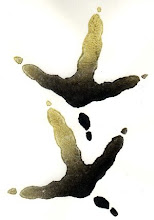
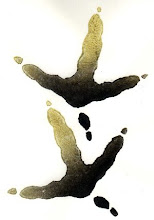
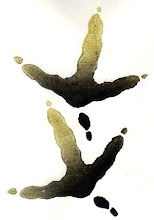
 Okay, efts -- red efts (newts when they're grown up spawning in a pond). In the spring they're everywhere moist in the turkey woods when the humidity is right. Vicious predators, prowling around the forest floor putting fear into the hearts of small invertebrates. Definitely a highlight of turkey season.
 And then another gobble, closer still, but... behind us. Quickly we shifted around to the other sides of our respective trees. Cluck-purr-cluck from the slate was answered by a gobble to our "new" front, and then by a gobble from behind! Now I was in the front shooting position, and Angela was behind me to my right. Another set of gobbles -- from front and rear -- and soon I could see a lone gobbler in full strut about 40 yards out front. My gun was up, hoping he'd close the distance before the birds got to us from behind. They had us sandwiched -- ideally we would've been facing in opposite directions, but it was too late to move now. The gobbler out front stepped closer in half strut, looking for us, and gobbled. I could hear the foot steps of turkeys behind us. The gobbler took two more steps, and "pow!" -- I popped him in the noggin.
 On the way home I stopped to photograph this bird with one of two junk cars that had survived being salvaged for scrap on a neighbor's woodlot. I don't know why they weren't taken away with the rest. These were the only two Hudson Super Jets in the bunch. Apparently early 1950s vintage.

 The text from the AP press release reads:
This map released by the Yale School of Public Health on Friday, Feb. 3, 2012 shows a map which indicates areas of the eastern United States where people have the highest risk of contracting Lyme disease based on data from 2004-2007. Researchers dragged sheets of fabric through the woods to snag ticks for the survey. The map shows a clear risk across much of the Northeast, from Maine to northern Virginia. Researchers at Yale University also identified a high-risk region across most of Wisconsin, northern Minnesota and a sliver of northern Illinois. Areas highlighted as "emerging risk" regions include the Illinois-Indiana border, the New York-Vermont border, southwestern Michigan and eastern North Dakota. (AP Graphic/Yale School of Public Health, Maria Diuk-Wasser).Oh well.

 When I'm hunting solo, I sometimes skip the new orange; but when I'm with some tree-swatting, covert-stealing flatlander from Pennsyltucky, I don my Filson orange in a can, and I'm good to go.

Keith, Mo and the kids served up incredible hospitality, smoked appetizers and, manicures. Yes, Victoria’s Paradise Spa is open for service, with rates so low it was impossible to leave without a few French nails and a painful eyebrow wax. Service was the theme of our visit, enough to make a visitor ashamed of the inadequate preparations he had made for Keith’s Pennsylvania deer visit earlier in the season.
Keith and Eric had scouted hard prior to our arrival. Canada Geese were relatively scarce – warm weather scrambling migration patterns - and the birds that were around had not been flying much. A brief cold spell brought a partial dusting of snow, just enough to preclude the use of the layout blinds but not enough to allow for snow camouflage. Compared with past years, things weren’t looking good, at least by our guides’ standards.
Our first day of hunting offered some of the best conditions of this year’s late season. We camped in an island of brush, visitors positioned in the best shooting cover, guides huddled under an obtrusive tree. The guides conferred over the best configuration for the decoy spread. All contributed to setting the many dozens of decoys: nodding full bodies, flocked shells, the occasional blue goose pair. Bobby marveled at the innovation and the investment.
The Canadas were late to fly. The first few flocks to visit our field were suspicious of something. Hypotheses were rendered. Decoys were reconfigured.
At long last a pair descended into easy range. The Pennsylvanian’s unloaded blunderbusts. I recall shooting at one bird, watching it fly a few beats, then surprised as it dropped, stone cold dead. Only then did I take note of the shot that had followed mine. Even trapped under a tree Keith wasn’t going to take any bird for granted.
For the remainder of the day, birds arrived at regular intervals. Large flocks would not be decoyed close enough to pinch. Smaller groups succumbed to our shots, more often than not. At one point a lone bird flew around the brush island. It was high, more than 50 yards above ground. “Take him,” whispered one guide to the other. An audible click, 10 gauge safety switched off, followed by a roar. I looked to the heavens and the bird actually dropped into my field of view. The fate of Icarus. It was a singularly impressive and memorable moment. Smoke wafted from Eric’s gun. Pride emanated from the gun’s owner.
We racked up the birds. Ten in the bag. Everyone was able to lay claim to at least two. Easy cleaning at Kuneytown on Eric’s tailgate.

Kuneytown cleaning fest
Scouting at day’s end didn’t come as easy as did the bird cleaning. The guides worked their phones and drove down roads following hunches. No good alternatives to that day’s field could be found. So it was that we decided to return to the site of that day's success.
Day two brought Rich, force of nature. Day two also brought an unwelcomed odor (no relation to Rich but also a force of nature). We had been watching manure spreaders zipping from barn to fields at the end of the previous day’s hunt. Even with a hard freeze it was clear that the ground had changed from yesterday's condition: 8,000 gallons of frozen porcine waste now plastering its surface. With wind from the south and a late start, we had little choice but to set the "spread" on the brown frost.
There are times when we use the term “blue bird day” euphemistically. This day - clear skies and very light southerly breeze - brought bluebirds to our feces glazed field. No Canada Geese. We watched flock upon flock of snow geese travel by. We made wonderful conversation. We lamented Rich’s absence the day before the manure had been applied. The day BEFORE, when the Canada Geese actually FLEW from their lake roosts to the grain fields. One Canada Goose did eventually investigate the stench, but it changed its mind when a hail of steel frustration shooed it away.
With the sun came the thaw. Not a welcome thaw. A dangerous thaw. Trips through the decoys became hazardous, slick slurry blanketing the once frictional surface. Olfactory senses overwhelmed all others as the atmosphere became more and more pungent. In the miasma hunters became light headed.
We weighed options. Rich developed ever more concern over work he had abandoned at the office. We worked ever harder to focus on the wonderful camaraderie we shared.

Rich, searching for an escape back to the office
By the time we decided to cut our losses, the flock of decoys - once proud replicas of migrating avian magnificence - had taken on the rime of a swine lagoon. Decoy collection involved strategies seldom considered when waterfowl hunting. How to optimize travel between decoys? How to stack the decoys so that only a few, sacrificial shells contacted the fetid earth? When Eric returned with four wheeler and trailer his tires issued rooster tails of rancid muck.

We walked back to the vehicles, marveling at the misery of this warm, sunny day. New Yorkers weighed the costs and benefits of cleaning older decoys. Pennsylvanians considered excuses for abandoning the gear they had worn that morning, if only to improve the car cabin air during the four hour trip home.
For the New York grousers, these two days of goose hunting may very well be ones they would soon forget, or would wish that they could forget. For the Pennsylvania grousers, the indelible memories of these hunts left no doubt that they would return in a year’s time. Regardless of the manure spreading conditions.
Hi Jim-So here are the pics, let me know if any of you are interested.
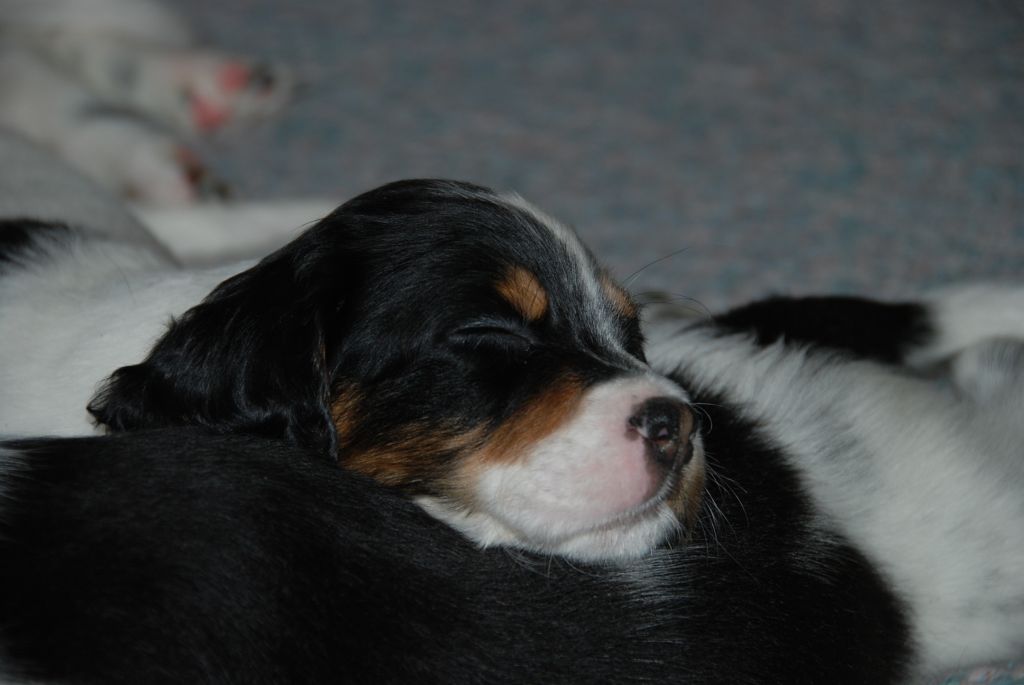
Any chance I could talk you into posting the attached photos of the last male pup I have available on your Grouser’s blog site?
All of his brothers and sisters went to new homes this past weekend but his prospective new owner decided at the last minute the timing was not right for him. I would be happy to send pedigrees, hip results for dam and hip/elbow/eye and thyroid results for sire. This little guy is 8 weeks tomorrow (1/10) and he‘s ¾ Llewellyn (sire is 100% registered Llewellyn with FDSB). My e-mail contact info for anyone with questions is jacaron@fast-air.net I could partially deliver him as far as Lansing on Feb. 6th if that would help someone who may be wondering how to arrange to get him.
The litter has been registered already with FDSB and he has first shots, dew claws removed and wormed. He will be a hunting machine by this coming Sept. and I’ll bet he will back his Aunt Phoebe.
I’ve also included one photo of his mom, my Daisy, after a short hunt around the house this past Oct. when she was 4 weeks pregnant. A solid memorable point on a grouse under a spruce that I proceeded to miss (followed up and got it though).
Thanks and feel free to send any photos you may have of Phoebe working the brush.
Jim Caron

 thanks.


Even with all of its ailments and insignificance, there’s not a member of this blog who wouldn’t see this little creek's potential. I covet it, although I could never afford to buy the farm through which it courses. Looking upon it I imagine a healthy riparian system with pothole ponds, trees, brush, flowers and wildlife. Like much of the land around my house it is a blank canvas.
Occasionally, the creek provides hints of what it would offer when healed.
I left work around 2:00 yesterday, heading home to watch the kids while Kelly shopped for their Christmas presents. It has been a gloomy week at work, federal budget cuts finally coming to roost upon our lab, and I had hoped at some point for a cathartic grouse hunt over Lilly. Now I had my beloved kids to factor in. Grousing seemed out.
We’ve had a lot of rain this year. More than 60 inches in an area that normally gets around 40. Recent rains had flooded wetlands along the drive home. By the time I rounded the last bend I had hatched a plan for waterfowl, unlikely as it seemed.
I stopped off at Bobby’s, my other neighbor, with the offer to swap my kids for a hunt with him. He has three daughters who bracket my kids’ ages, so the proposition wasn’t as unreasonable as it might sound. Bobby had seen ducks along the creek earlier in the week, and was nearly swayed by the offer. But, he had work to do making his participation out of the question. I couldn’t muster the chutzpa to ask if I could just drop off my kids without some form of reciprocation.
I’ll take them with me I decided.
So it was that we three marched with Lilly across my little farm, past my equipment shed, and down the lane to Half Moon Creek. I let Lilly run much of the way, stretching out her long legs after a day cooped up in the house. She ranged widely. Before I knew it she had reached the creek by the bridge and was making for the water. I called her back. Here! Here! Here! She returned reluctantly. So much for a sneak.
Even so, I was committed to the plan to stalk the remaining length of the creek. Kids trailing by a few yards. Dog on heel. Occasionally poking over the bank to search its contents.
Nearing the creek we cut off the laneway, bypassing the stretch that Lilly had travelled. I was surprised by the noise of stiff feathers launching birds from near the bridge. Two mallards rose, not 30 yards from my position and only 10 yards from the spot Lilly had momentarily visited.
I wheeled, noting the kids – great kids – were exactly where I had told them to be, several yards behind me.
I picked the green head and shot.
The bird flinched, but kept flying. Off, down the valley with its mate. Lilly trailing at full speed.
Wait. While the hen headed skyward the drake remained only 10 yards above the flood plane.
Dog and bird covered 300 yards in seconds.
Then the bird wheeled down to the creek. Lilly hot behind.
We waited. After a minute I told the kids to wait in the open at the bridge so that Lilly would see them and return to them with duck if she found it. I headed down the other bank to help dog locate bird.
50 yards downstream I saw Lilly racing back to the kids. No bird.
Here! Here! Here! She snapped to me. Launched herself, 10 feet across the creek. Bank to bank. A spectacle of athleticism.
We hunted the final yards downstream. Another bridge crossed the creek. Lilly ran across it and under it. I could see her stop momentarily, scooping the bird up. I didn’t even need to call her. She came. Fleet, fluid motion. Bird in maw.
The drake was very much alive when she dropped it off. A crisp retrieve.
We returned to the kids, waiting for us at the bridge where I had left them. Cheers went up when I hoisted the bird. Mallard! Mallard! Then excited prattle about Christmas duck and Christmas presents and Christmas music and duck feathers on our Christmas tree.
We walked the long lane home. Half Moon Creek babbling behind us. Nearly bank full.


 Posts
All Comments