Showing posts with label sporting art. Show all posts
Showing posts with label sporting art. Show all posts
Thursday, September 03, 2009

Saturday, December 06, 2008
One more day
Last day of deer (shotgun) and duck (first split) tomorrow in Western New York. Good luck to all in pursuit.

An illustration from A. B. Frost, The American Sportsman’s Artist" by Henry W. Lanier.

An illustration from A. B. Frost, The American Sportsman’s Artist" by Henry W. Lanier.
Monday, August 21, 2006
goose pimples for early goose
Here's another oldie but goodie to get you all pumped up for early goose--or as we in the nuisance sniping trade like to call it, the September Nuisance Goose Season.

Frederic Remington, "Goose Shooting"
I'm wondering what goose sausage would taste like . . . .

Frederic Remington, "Goose Shooting"
I'm wondering what goose sausage would taste like . . . .
Monday, August 07, 2006
I got tired of Vassili's fan mail
Here is some sporting art to get us in the mood for the upcoming hunting season. I don't know about you all, but I can't wait to be surrounded by dead thangs.
 The painting is a self-portrait by Alexandre François Desportes, circa 1699.
 The painting is a self-portrait by Alexandre François Desportes, circa 1699.
Wednesday, February 22, 2006
Heroes of Modern Sporting Art, continued
We haven't posted anything new and exciting lately in the Grousers "Heroes of Sporting Art" category, so here is today's entry:

Clearly this is a sculpture--life size, I might add, by Jeff Koons--of celebrity Michael Jackson who has just returned from a successful monkey hunting excursion. As you can see, Michael has "field dressed" his quarry in the typically whimsical and appropriate Jacksonesque style, just the thing to amuse any children who may be visiting him at the moment at Neverland.
For more about this sculture, check out this link. There's quite a lot out there about Koons but also about this particular Michael Jackson piece.
As an aside, this reminds me of our Maine grouse camp conversations of 2003 (?), where Peter K. regaled us with tales of Monkey Brain Masaman and other possibly apocryphal culinary tales about brainfood across the cultures.
Brain appetit!

Clearly this is a sculpture--life size, I might add, by Jeff Koons--of celebrity Michael Jackson who has just returned from a successful monkey hunting excursion. As you can see, Michael has "field dressed" his quarry in the typically whimsical and appropriate Jacksonesque style, just the thing to amuse any children who may be visiting him at the moment at Neverland.
For more about this sculture, check out this link. There's quite a lot out there about Koons but also about this particular Michael Jackson piece.
As an aside, this reminds me of our Maine grouse camp conversations of 2003 (?), where Peter K. regaled us with tales of Monkey Brain Masaman and other possibly apocryphal culinary tales about brainfood across the cultures.
Brain appetit!
Tuesday, February 21, 2006
Vicar, you free-riding parasite . . . .
heh heh. You heard me right: Mr. Mike's numbers don't lie. (nice wav file, btw, Mr. M) You sir, are a disgrace to grouse gabdom. Here all along I've thought you were doing your fair share, holding up your end of the bargain, etc. etc. You know, I believed that you were a real "Camp Man," as the Captain of Old T might put it.
But now I learn that you're nothing but a free-loading blood-sucking tic on our grousers' collective arse. And that goes for you too, Kleinpuppy. The gloves are off. I'm spitting mad, phtew, phtew.
So all you free-loading hosers get your fingers on the keyboard and start writing some comments AT THE VERY LEAST, sheesh fer frigginchrissakes. Cause it's lonely here in the blogger.com control booth, writing my heart out day in and day out, spilling my guts for the entire internet community, and for what? This is the thanks and gratitude that Mr. Mike and I get for our literary output? Almost enough to make me ashamed to be a grouser.
So snap out of it, fellas. Give us a sign that you're at least reading these things. Crickets chirping, whatever--a little bit of appreciation goes a long way.
Otherwise, I'm gonna start spamming your boxes with multiple copies of every post that makes it onto the blog--Cheney haiku included. And that's not a threat . . . that's a promise.
heh heh
 I can barely stand it any longer . . .
I'll tell you where the bear shits in the woods.
But now I learn that you're nothing but a free-loading blood-sucking tic on our grousers' collective arse. And that goes for you too, Kleinpuppy. The gloves are off. I'm spitting mad, phtew, phtew.
So all you free-loading hosers get your fingers on the keyboard and start writing some comments AT THE VERY LEAST, sheesh fer frigginchrissakes. Cause it's lonely here in the blogger.com control booth, writing my heart out day in and day out, spilling my guts for the entire internet community, and for what? This is the thanks and gratitude that Mr. Mike and I get for our literary output? Almost enough to make me ashamed to be a grouser.
So snap out of it, fellas. Give us a sign that you're at least reading these things. Crickets chirping, whatever--a little bit of appreciation goes a long way.
Otherwise, I'm gonna start spamming your boxes with multiple copies of every post that makes it onto the blog--Cheney haiku included. And that's not a threat . . . that's a promise.
heh heh
 I can barely stand it any longer . . .
I'll tell you where the bear shits in the woods.
Friday, January 20, 2006
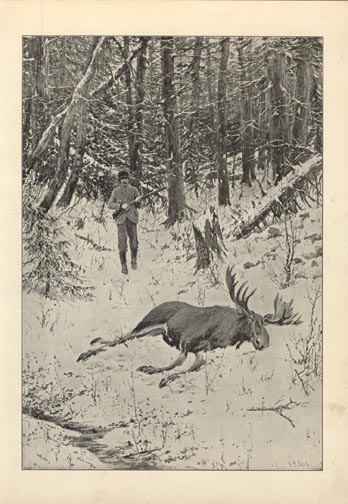
Heroes of Sporting Art: Pathwalking Moose Hunter
 Hey gang,
Once again it is time for another installment in our "Heroes of Sporting Art" series of postings. Today we have A. B. Frost returning with a print of "Pathwalker and the Moose." As you can see at right, here our hero PW is walking down the path to the moose he has just slain with what looks to be a Winchester repeater. (Newsflash this week: Winchester will no longer be making guns in its New Haven, Connecticut plant after they close the plant later this year.)
I ran across the following film footage of a newscast about Vermont moose hunting. The short 4 minute film can be viewed with either QuicTime or Windows Media Player 9.
For folks who can't get enough A.B. Frost, here is a closeup detail of the moose hunter print. PW, it looks like your hands are cold without gloves--and how do you get the moose out of the woods, anyway?

Thursday, January 19, 2006
More on samurai, hunting, and art

More on samurai and hunting: here is a photo of a nineteenth century folding screen depicting samurai hunting wild boar at the foot of Mount Fuji. The description from the museum exhibition in Denmark:
Samurai on a wild boar hunt at the foot of Mount Fuji. Folding screen decorated by the Japanese court artist Kanô Tangensai Fujiwara Moritsune (1829-66). Ethnographic Collection, National Museum. The screen was presented to King William III of the Netherlands in 1860 by the ruling Shogun of Japan, Tokugawa Iemochi.Also, it may be of interest to some grousers that you can still hunt wild boar in this country using samurai swords (Sporting? discuss). See:
Photo: Arnold Mikkelsen
www.a-wild-boar-hog-hunting-florida-guide-service.com
October 4, 2003
Wild boar sword hunters Jack Chuang (Davie, FL - e-mail: threeinchman@earthlink.net), non-hunter Jerry Chuang and Jason Jen bagged 3 wild hogs during a morning of wild boar hunting with Ron's Guide Service on October 4, 2003. Jack (above) killed a big sow hog with a samurai sword. Jason (below) killed 2 wild boar hogs with a samurai sword. They hunted the sugar cane fields in the town of Lakeport.
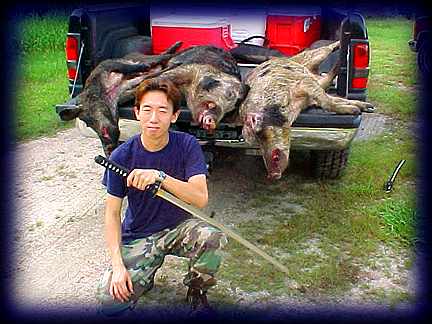 Now THAT looks like fun. Who's with me? Next year, pig sticking hog camp in Florida. Bring your 12 gauge sabers.
Friday, January 13, 2006
Heroes of Sporting Art, continued: Alexander Pope
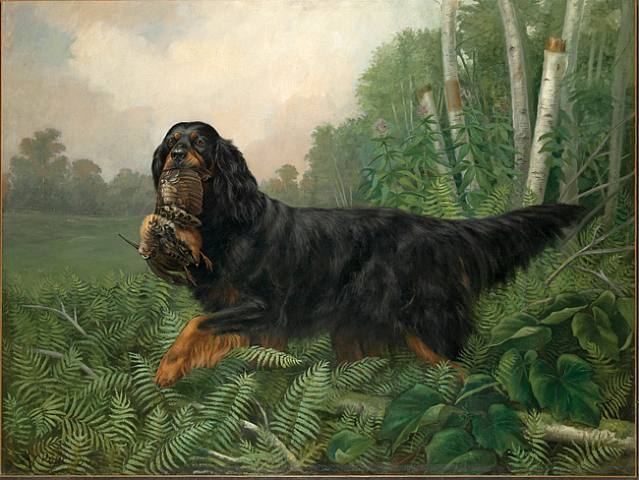
Here's a nice portrait of Safari Jim's Thor, God of Thunder, doing his thing. The artist is Alexander Pope, who is well known for his wildlife portraits. Here are his vitals:
Artist Biography: Alexander Pope
Origin:United States
Profession:Painter and carver
Born:March 25, 1849, Dorchester, Massachusetts
Died:September 1924, Boston, Massachusetts
As a youth, Alexander Pope carved and sketched animals around his home in Massachusetts. In the 1860s, he worked for his family’s lumber business. Pope studied carving, painting, perspective, and anatomy with William Rimmer, an important romantic-baroque sculptor, painter, and influential teacher of many Boston artists. From 1879 to 1883, Pope created many well-received carvings of game. Czar Alexander III of Russia acquired two of the carvings. In 1893, Pope began painting animal portraits and, later, pursued a career as a portrait painter. Eventually, he was considered one of the best Bostonian trompe l’oeil painters of the nineteenth century. The French term trompe l‘oeil means deception of the eye. Trompe l’oeil paintings appear so real that they trick the viewer into thinking they are seeing an actual scene rather than a painted one.
Pope is particularly well known for his illusionist paintings and wood carvings of birds, rabbits, and firearms hanging on slate-colored doors. Side by side in the JKM Gallery, the National Museum of Wildlife Art’s painted Hanging Grouse and carved Mallard Against A Woven Basket both are illusionist renderings of ducks strung up against slate doors.
Pope’s work is recognized in many private collections and museums, including the M.H. De Young Memorial Museum and the National Museum of Wildlife Art.
There you have it. Nice looking dogge, too.
Monday, January 09, 2006
News from the Art World
 Start getting geared up for the "Dogs in Art" auction that coincides with the Westminster Dog Show every year in February.
Last year, the painting on the right, "October on Grassy Field", went for a cool $120,000.
October on Grassy Hill, Portrait of ‘Transue Bill’ and ‘Glensale Harry’ on Point by Percival Leonard Rousseau (American, 1859-1937) proved to be another highlight. Rosseau was often invited by his patrons to hunt and paint on their estates. Most prominent was Percy Rockefeller, who made Rosseau a member of the hunting club on his estate in Fayetteville, North Carolina and erected a studio for Rosseau there. This 28-3/8 x 34-1/4 inch oil on canvas was estimated at $50,000 – 70,000, and realized $120,000, a world record for the artist.So Mike, I hope your soda cans are in order. The Rousseau that will be auctioned off this year is "Setters on Point," below. See www.doylenewyork.com for more information.

Thursday, January 05, 2006
Heroes of Sporting Art, Part Two
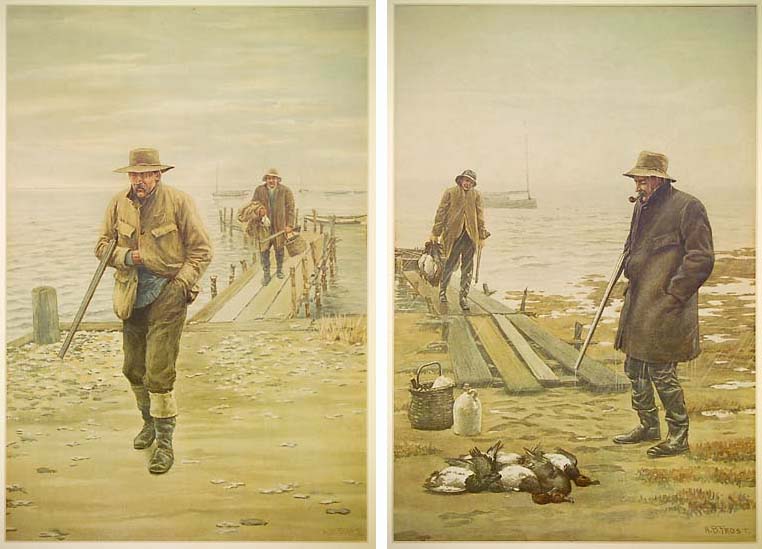
These were originally titled "Bad Luck" and "Good Luck."
Somehow, I've always thought of them as "Kleinpuppy at Black Lake" and "Cabin Boy and Mike O'Connor at Black Lake."
Funny how the mind works.
The artist again is of course A. B. Frost.
Wednesday, January 04, 2006
Au contraire! Wispy haired pointy dogges are just perfect for late season on-ice duck work
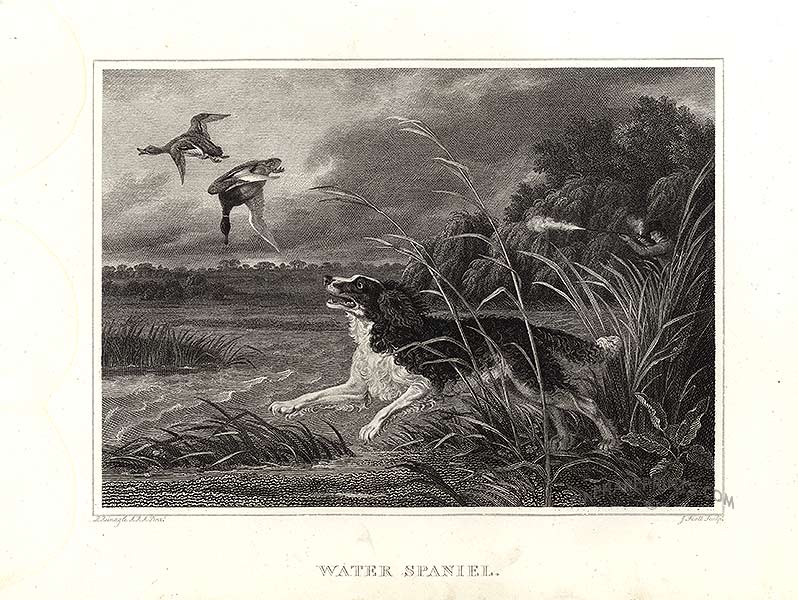
With a spaniel the rule is drakes only
Which results in hen mallards that are lonely
But when the lake's froze
The rule is anything goes
You can even use that setter lying pronely.
Why cats are a threat to sportsmen
 Long time students of my academic . . . ahem . . . "career" will know that I have taken an interest in the subject of feral cats. What many people don't know is the actual reason cats are such a threat to sportsmen and the wildlife sportsmen like to kill.
Research in this area has proven inconclusive to date. Interested sportsmen would do well to turn to the following source to understand the considerable complexity of the issue:
Tantillo, James A. 2006. "Killing Cats and Killing Birds: An Overview of Philosophical Issues Involving Feral Cats and Wildlife." Consultations in Feline Internal Medicine, Fifth Edition, ed. John R. August (Philadelphia: Elsevier), 701-708.
(That's a real citation, by the way--not a gag.) (Although of course the article may make you gag.)
This picture, however, finally provides definitive proof that cats and bird hunting do not mix.
Wildlife managers who are concerned about feral cat population control management would do well to watch the following video on cat handling techniques.
Tuesday, January 03, 2006
Heroes of Sporting Art, Part One
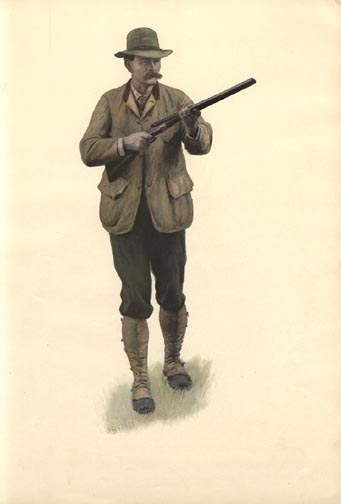
One of my favorite sporting artists is A. B. Frost, who painted numerous hunting and fishing scenes over the course of his career. At right is his painting of The Huntsman, and many of his images depict bird hunting in one form or another.
Biographical info on Frost is surprisingly difficult to locate. Here is the biographical entry for A.B. Frost at Wikipedia:
Arthur Burdett Frost (January 17, 1851 - June 22, 1928) was an early American illustrator, graphic artist, and comics writer. He was also well known as a painter. Frost's work is well known for its dynamic representation of motion and sequence. Frost is considered one of the great illustrators in the "Golden Age of American Illustration". Frost illustrated over 90 books, and produced hundreds of paintings; in addition to his work in illustrations, he is renowned for his realistic hunting and shooting prints.
Frost was born on January 17, 1851, in Philadelphia, Pennsylvania, the eldest of ten children; his father was a literature professor. He became a lithographer, and in 1874 he was asked by a friend to illustrate a book of humorous short stories, which was a commercial success, selling more than a million copies.
In 1876, Frost joined the art department at the publisher Harper & Brothers, where he worked with such well-known illustrators as Howard Pyle, E. W. Kemble, Frederic Remington, and C. S. Reinhart. While there, he learned a wide variety of techniques, from cartooning to photorealistic painting. Frost's color blindness may have helped his excellent use of grayscale. In 1877 and 1878, Frost went to London to study with some of the great cartoonists of the time. Later, he returned to Philadelphia and studied under painters Thomas Eakins and William Merritt Chase at the Pennsylvania Academy of the Fine Arts.
Soon after returning, he published several stories formed of sequential drawings with captions, pioneering the form that would later develop into comic strips and comic books. In 1884, Frost published Stuff and Nonsense, an anthology of his previous works that advanced the concept of time-stop drawings and contained several other innovations.
From 1906 until May of 1914, Frost and his family lived in France, attracted by the impressionist artistic movement. Upon returning to the United States, he continued work as an illustrator and comics artist, mainly for Life magazine. Frost died on June 22, 1928.
I'm not sure I realized how influential Frost was in the development of early comics. I'll try to post more sporting images from Frost in the coming days.
Our two heroes out kite killing?
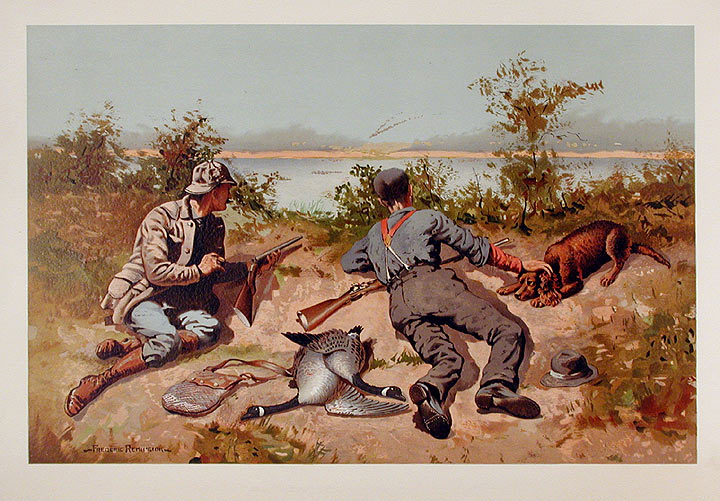
You be the judge. I bet no one here realized that Frederic Remington painted the fine art of kite killing in his oeuvre . . . .
Is this a Gordon or a Gordie?

While I sit here and waste half the day waiting for a tow truck, I'm perusing the sporting print dealers for next year's Christmas gifts. Check out the above print. Here is the dealer's info:
A.F. Tait. [Hunting dog] Boston: L. Prang & Co.(?), 1868. Chromolithograph. 9 3/4 x 12. Mounted on board as issued. Very good condition. In period frame.Chromolithography was developed by publishers in the later part of the nineteenth century as a medium to produce inexpensive prints that filled the demand for attractive images to hang in homes of those that could not afford original paintings. Sporting art was quite quite popular at the time, so a number of chromolithographed prints were made with hunting and fishing scenes. Perhaps the greatest of the sporting artists of the period was A.F. Tait, who produced images for prints made both by Currier & Ives of New York and L. Prang of Boston. This is a lovely example of his work, perhaps issued by Prang. $550
Mike, if you collect enough soda cans, this print can be yours.
Sunday, January 01, 2006
Let's start the new year off right

Why not start the new year off right with a quote from Burton Spiller:
A good dog, and he must be a good one, is absolutely essential to the utmost enjoyment of grouse hunting. I do not mean that it is necessary to have a dog in order to kill grouse. There are other systems whereby they may be killed just as dead and in just as great numbers; but I repeat that a good dog is essential to the utmost enjoyment of the game.Ol' Burt goes on to say, "Setters were my first love . . . ."
The image above is of "Toledo Queen," by Edmund Osthaus.
Tuesday, December 20, 2005
Tragic Pleasure, Tragic Wisdom
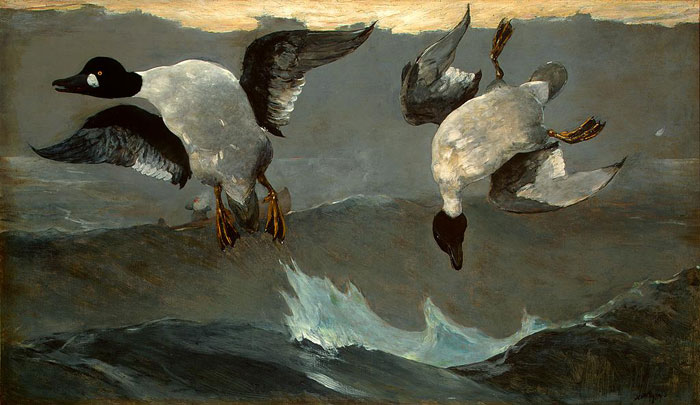
Last one for now: Winslow Homer's Right and Left.
From the National Gallery of Art http://www.nga.gov/feature/homer/homer28.htm :
Homer painted less frequently in the last decade of his life. The paintings he did produce, deepened by intimations of mortality, include some of the most complex pictures of his career.
Right and Left, one of Homer's last paintings, is at once a sporting picture and a tragic reflection on life and death. The title refers to the act of shooting the ducks successivelly with separate barrels of a shotgun. The red flash and billowing gray smoke barely visible at the middle left indicate that a hunter has just fired at the pair of goldeneye ducks. The picture captures the moment but leaves important questions unresolved. Has the rifle hit its mark? If so, does the downward plunge of the bird on the right indicate that it has been hit, or is it diving to escape? The duck on the left seems frozen, but that stasis does not necessarily reveal its physical condition. And consider the precarious position in which Homer has placed the viewer, observing the scene while apparently hovering in mid-air, at one with the threatened creatures—and directly in the path of the oncoming shotgun blast. With its ambiguous message, unconventional point of view, and diverse sources of inspiration ranging from Japanese art to popular hunting imagery, this painting summarizes the creative complexity of Homer's late style.
Although Winslow Homer avoided any discussion of the meaning of his art, the progression of his creative life attests to the presence of a rigorous, principled mind. Continuously refining his artistic efforts, Homer created work that was not only powerful in aesthetic terms but also movingly profound. Acclaimed at his death for his extraordinary achievements, Homer remains today among the most respected and admired figures in the history of American art.
There you have it . . . .
Subscribe to:
Posts (Atom)


 Posts
Posts